How do you track several roles without duplicating a person?
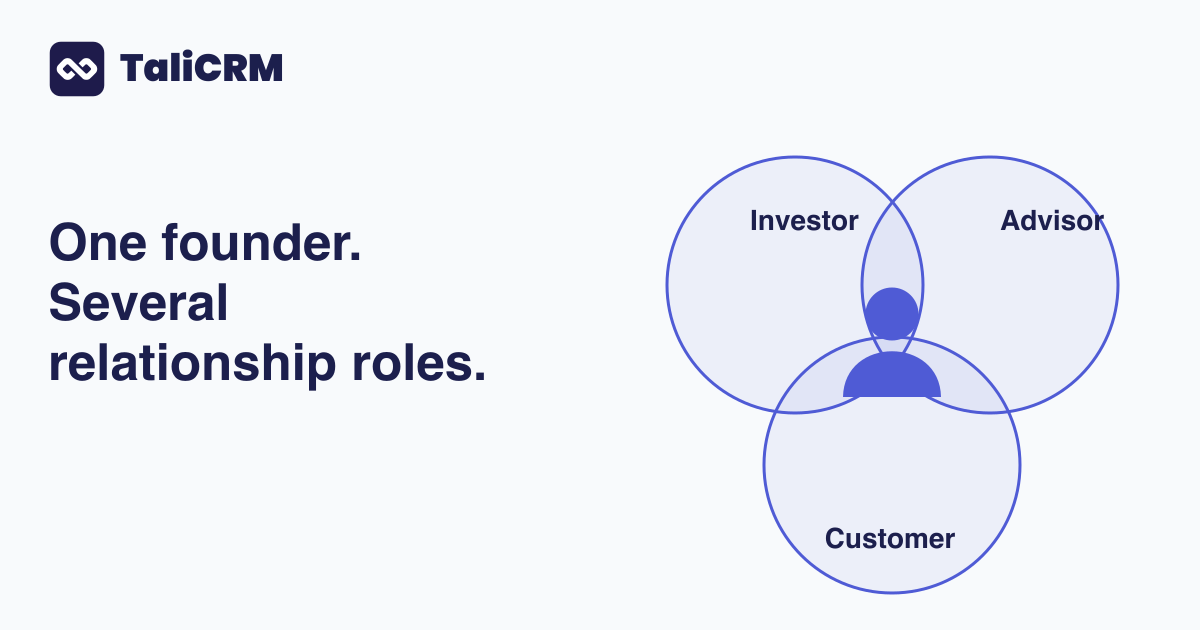
Someone may be a customer, advisor and potential investor at different times. Creating separate records for each role splits the history and makes it easier to miss a promise. Keep one contact identity and use role labels or clear notes to distinguish the conversations.
A role label is a retrieval aid. It does not imply that the person has committed to invest, advise or hire. "Investor conversation" may be accurate where "investor" would overstate the relationship.
TaliCRM provides contact capture, notes and tasks. Review the identity before adding a new record, especially when someone has changed companies or reached you through a different introduction.

What should you save about investors, advisors and customers?
Swipe or scroll horizontally to read all three columns.
| Role or conversation | Useful context | Next-action example |
|---|---|---|
| Investor conversation | The questions asked and actual milestone discussed | Send the agreed public update after the pilot. |
| Advisor or mentor | Advice given, introduction offered and permission | Thank them and report what you tried. |
| Customer | The problem described and decision still open | Clarify which onboarding issue needs attention. |
| Potential hire or peer | Professional interests and agreed timing | Share a relevant public role if invited. |
Avoid turning a tentative comment into a firm promise. "Would be interested to hear after the pilot" is not a funding commitment. A contact record should preserve that uncertainty instead of quietly moving someone into a fictitious stage.
Keep confidential investor, employee and customer information only in systems that fit your actual permissions and obligations. A personal relationship record is not evidence of a team access model or compliance controls.
How do you turn relationship context into a useful next action?
This is enough to continue the exchange. It separates advice from your own promise, and it includes a sharing check before you send. You do not need a general "keep warm" task that gives you no reason to write.
For commitments from a meeting, check the action, owner and timing before making them tasks.
How do you capture a person and review their meeting?
Use the source you have: a card, a shared profile URL or your own short note. Check the contact details. Add where the introduction came from and why you were speaking.
For a call that you are permitted to record, choose the supported option on the TaliCRM recorder page, disclose the recording and follow the applicable policies. After processing, check the summary and confirm or assign the contact in Meeting Inbox when needed.
Before the next conversation, retrieve the last decision, open promise and next question. The value is continuity across your conversations; capture does not eliminate correction or follow-through.
When do you need a separate sales or fundraising system?
A founder can need a sales CRM for a customer pipeline, a hiring system for candidates and a structured fundraising process. Those tools may have their own permissions and reporting. A personal CRM can complement them by keeping your individual relationship context; it should not silently become the system of record for every company process.
Founder products also address different jobs. Dex has a founder use case, while Happenstance discusses founder network work. Evaluate the job you need rather than assuming any personal CRM includes investor directories, a warm-introduction graph or fundraising operations.
How can you evaluate a personal CRM during your first week?
- Add the people from a few recent relevant conversations.
- Check identity and add a role or context note.
- Record the next action you actually owe.
- Return to one record before the next exchange.
- Update the outcome and keep the new history dated.
This is an evaluation plan, not a promise that setup takes minutes or produces revenue. If it helps you answer a real relationship question, expand the set. If it duplicates another system, change the workflow before adding your entire address book.
For event introductions, review the event batch and prioritize agreed actions. Avoid a bulk import as a substitute for knowing what the record is meant to help you do.
How do you choose a personal CRM for founders?
Start with a retrieval test, not a feature checklist. Choose a recent conversation and try to answer: who introduced us, what did we discuss, and what do I owe? Repeat the test for someone whose role has changed. A system that stores an email address but loses the history will not solve this particular problem.
Compare the options against the work you actually perform. These are workflow choices, not a ranking of products or a claim that every tool in a category has the same features.
Swipe or scroll horizontally to read all three columns.
| Approach | Useful starting point | Test before committing |
|---|---|---|
| Contact list and notes | A small set of active conversations | Can you find the latest decision and next action together? |
| Spreadsheet or document database | You want to design your own fields | Will you maintain dated notes without overwriting history? |
| Personal CRM | Your recurring question concerns a person and past conversations | Can you capture, correct and retrieve the context in your normal routine? |
| Company process system | Several people manage deals, hiring or approvals | Does it provide the access, reporting and ownership your team requires? |
For the personal relationship part, examine TaliCRM's founder contact workflow using your own permitted example. Judge whether the reviewed notes and next action make the next conversation easier to prepare for. Do not import your whole network before testing how you will maintain it.
Include an exit question in the evaluation: what information would you need if you changed tools? Check the current documentation or ask the provider about export formats, attachments and meeting records. Do not infer portability from a screenshot or assume one export contains every type of data.
How do you keep founder contact records useful as relationships change?
Date the context and record the source. In this fictional example, Jordan was introduced by Alex at a product roundtable. Jordan initially gave customer feedback, then joined another company. Update the current company while retaining the dated feedback note. Do not rewrite the old meeting as though Jordan held the new role at the time.
Use explicit wording for uncertainty: "Interested in a future update" is a note about a conversation. "Committed investor" is a different claim. Likewise, an offered introduction is not a completed introduction. Record the permission you still need and who will make the next move.
During your own review, look for records with an unfinished promise, a changed role or an unclear identity. Resolve those before adding optional enrichment. If two records appear to describe the same person, compare email, company and the original introduction. Avoid combining people merely because their names match.
Keep sensitive operational details in the appropriate company system. Your relationship note can say "Follow up through the existing hiring process" without duplicating interview assessments. The purpose of the note is to help you act appropriately, not to collect every available detail about a person.
What else should founders know before choosing a personal CRM?
Can a spreadsheet work as a personal CRM?
Yes, if you maintain identity, dated context and next actions consistently. Test whether you can recover a conversation without searching several unrelated files. Consider a dedicated tool when the maintenance or retrieval work is getting in the way, rather than switching because you reached an arbitrary contact count.
Can I use a personal CRM for investor relationships?
You can keep the conversation history, the introduction and your agreed next step. That does not make the record an investor database or fundraising pipeline. Keep investment documents, decisions and company reporting in the systems selected for those purposes.
What should I record after an advisor call?
Write the advice, the assumption behind it, what you chose to try and any update you promised. Keep your interpretation separate from the advisor's words. Before asking for another favour, check whether you completed the previous commitment.
What belongs in the first set of contacts?
Start with people connected to real upcoming conversations or promises. Contact management for founders is most useful when each saved record has a reason to be revisited. Expand after the routine works for those active relationships.